Showing posts with label Gore Horror. Show all posts
Friday, November 7, 2008
Wednesday, November 5, 2008
raves reviews revelations
STEP BROTHERS
After back-to-back missteps of vacuity, i.e Blades of Glory, Semi-Pro, Will Ferrell gets it on like he should with Adam McKay, their 3rd whimsically vulgar collaboration following Anchorman and Talladega Nights, drag-assing the indomitably ethereal John C. Reilly along for some ebullient, wide-eyed and high-hearted bumpus time. With Step Brothers, McKay and Ferrell again use the built-in genre excesses of frat-row comedy to deftly probe what's steadily becoming their intaglio MO: monochromatic social congeniality and formality as cultivated and disillusioned by cultural susceptibilities to submit to the stagnancy of comfort and convenience as manifested from economic and consumptive disenfranchisement and fear of change, as well as the bungling and sophomoric American expression of male bond and sexuality. Mouthful.
Step Brothers was one of the most solid and entertaining comedic chestnuts of the last couple years and a tender keeper. But, as much as I regret to say this to a fellow alum, Will Ferrell's brand of wide-eyed, trusting, irreverently spirited comedic sentiment is nearing its course's end. Maybe within the next half-decade there'll be a tangible transition toward a sense of comedy elaborating on Ferrell's ironic search for sincerity, something that strokes with more focused self-awareness and resolve while sustaining that cherub wonderment. Step Brothers, the title suggests a yearn beyond cynical irony, a near-genuine yearning for brotherly unanimity.
Will Ferrell is the most important comedian of the 21st century, at least. Steve Carrell gets honorable mention.
WALL-E
Pixar delivers another gem, possibly the studio's masterpiece so far. Apart from Cars, Pixar Animation hasn't miscued. What makes Wall-E particularly brilliant and revelatory is its ability to communicate with enduring simplicity its universals of Love, Purpose and Responsibility, all basically without the crutch of talk and rhetoric. This is what children's high-fantasy and Horror as polarized genres can achieve, the purity and universality of the eternal laws governing us, of the potentials we have to ascend and of the temptations which cause us to fall.
I'm searching for my Eva...
MIRRORS
Splat Pack members Alexandre Aja and Gregory Levasseur return with their 3rd gore galore (High Tension, Hills Have Eyes), and it's a studiously adept if underwhelming massacre. I applaud them, at the very least, for attempting to construct and examine the social and perceptional ramifications of mirrors as literal and symbolic artifact for vanity, consumer culture and existential distortion. But generally, the French haven't got the eyes for real, raw horror. Their experienced, fluid narrative romanticism works against them in this genre, aesthetically and sentimentally. Some of these directors included loosely in the Splat Pack don't make the grade; of the ones listed on Wiki (Aja, Darren Lynn Bousman, Neil Marshall, Greg McLean, Eli Roth, James Wan & Leigh Whannell and Rob Zombie) I would in all generosity drop Bousman, Wan & Whannell. The Saw series is like all the insulting sequels to Friday the 13th and Halloween packaged into something slightly and modernly less inane. Wolf Creek by McLean was frenetic and a skilled orchestration, but all aesthetic. Neil Marshall's a solid commercial director and The Descent was one of the best Horror films of the past few years, but Doomsday was a huge letdown. I liked Zombie's Devil's Rejects, but he's obviously limited. Of this list, Eli Roth is the only true auteur. He could potentially be one of the finest auteurs in cinema's future, if he doesn't let the celebrity get to his creative virility, which is very viable risk with Eli.
Speaking of the Horror genre, look out for the writer/director of Transmission 1 from The Signal.
HANCOCK
I felt cheated. Rather, my feelings were voided. So po-mo. Similar to Iron Man, Hancock was just a fragmented, postmodern collage of scenes brusquely and clumsily strung together to construct some undercooked narrative of coolness. In another potential-unrealized flop by Will Smith (the other being I Am Legend), Hancock was particularly a frustrating disappointment because there were many flowers which under the brass knuckle direction of Peter Berg weren't able to blossom. Hancock was the epitome of manufactured sincerity and the aesthetic cover-up of a film under-conceived. This hearkens back to the Iron Man comparison because Berg and Favreau are both comedic actors-turned empty flash directors and were co-stars in Very Bad Things. Now, as directors they suffer from the same postmodern symptom, overstatement and lack of fluidity. There's more to say, especially about the amateurish subterranean commentary on true masculinity, but I'm over this blog. I will give props Jason Bateman, as well as Vincent Ngo, my fellow Vietnamer, for writing the script 12 years ago.
Wednesday, August 13, 2008
midnight meat train
Saw this contemporary horror classic a few weeks ago at the Fantasia Fest in MTL. The word on the street's that due to some internal studio politics the movie got only a very limited release, a fuck-all shame in my opinion. This one garnered much buzz being a Clive Barker bullet, and with sure-handed direction from Asian import Ryuhei Kitamura it didn't disappoint - and actually surpassed my expectations. Kitamura's one of the rare Asian horror imports that didn't implode under the anxiety of cultural turn-over. Though, he did have some issues with capture and pace with the few domestic-related scenes, but gets a mulligan. Midnight Meat Train was a kitsch, moody, gory, technically-adept crowd-pleaser, all the components of a solid post-millennium horror flick. The separation from its inept, manufactured contemporaries lies in its meta.
Firstly, the fact alone that it had exegesis should be applauded in a film. You could say MMT was a riff on Blow-Up, but cultivated from one of the premier exemplars of postmodern manifest, Clive Barker. He asks us: Who is the killer, the actionable party or the voyeur capturing the action? Who is the grander perpetuator, the media who feeds us or us who feed the culture of the media? Who's more perverse, who's the pervert, the criminal? The line's atom-thin between perpetrator and perpetuator. The voyeur becomes what he shoots. His perception of reality suffers and turns into depraved disillusionment.
Though, my only dissatisfaction of MMT was the concluding anti-hero nihilism: that you, in fact, become in the flesh what you shoot, embody it and redemption turns a way of succumbing. I mention "anti-hero" because in a grander postmodern sentiment, Bradley Cooper's character's a guardian of sorts, maintaining the equilibrium of two disjunctive realities from colliding. This, though quintessential artifact of the last whimpers of postmodernity, works as a sterling reminder to our moment that cuts the glossy crust away from manufactured sincerity and aesthetic dismemberment that still pervades.
Sunday, June 29, 2008
horror for your soul power
I proclaim this without exagerration: The Signal possesses (semantically deliberate, it POSSESSES) one of the most intensely and triumphantly frightening introductions in horror cinema history. In every cinematic facet, the first 30 minutes, or Transmission 1, are near flawless evocation of carnal horror.
The flick is segmented into 3 sections, or Transmissions, and each is composed and directed with variant and purposeful tone by three singular minds, with extraordinary results. The Signal, thus far, is the nearest to New Sincerity horror, in execution and purpose, I've yet to see. An apocalyptic narrative set in a city aptly named Terminus, The narrative follows a man searching for his love as the existence around him crumbles into primordial violence and irrationability stemming from a seductively-mysterious transmission coming from all forms of airwaves. Transmission 1 may be the hallmark of the 3 transmissions, filmed in a unsettlingly realist style, and works in the broader conceptual theme as Modernity - linear and at-your-door.
Transmission 2, however, derails the momentum that its predecessor builds by escaping into a satirical, sitcomesque tone. Though, in itself a letup, this segment is equally deliberate and vital to the film. It's not only necessary, but a sacrifice on the part of the craftsmen in favor of the greater meaning of their work. I applaud their nobbility even if the results sour the film's entertainment value. The surrealism of Transmission 2 is that of postmodernity - the detachment and satirization of the present danger, one of which we all know very well and one that still lingers in our collective consciousness.
In Transmission 3, the conflict of the film is fully realized: the abstraction of reality by aforementioned transmission, the perversion that has led us to unravel and in the process, lose our self-identity, our soul. This last trasmission an exemplary artifact in examining the artistic tenets of New Sincerity. Throughout, it weaves seamlessly, even deceivingly (but relative to postmodernity, with purposeful aim), between linearity and perceptional disorientation. Compositionally and tonally, it flows with naturalistic style, like the natural world, unsentimentalized, but at the same time, grounded and romantic.
The degrading transmission is not just that of media. No, it is that of meaningless aesthetics and nothingness. These are such perversions of our reality that corrupt our identity and the potential of our current reality. Before the film comes to a close, we are thrown a last deception, one that flashes forward and shows the two main characters successfully escaping from Terminus, alive and lovingly in each other's warm embrace. But we are jolted back into the blunt reality, that this was only a daydream. The woman lies still, numb, comatose, and the man desperately scrambles to save her from the sickeningly-convuluted transmission. The prior would be a cop-out, a submission to the transmission itself. For the ending would be sentimentalized and void of true repercussion, and thus, true redemption. Because in our current juncture, we may be there, but we are not yet. This struggle of ours is still fragilely open-ended. Will we find again our identity, muddled and masked behind all the hollow currents of transmission? Will we find our purpose, the art that is us?
The Signal ends, or rather begins, with the man sliding headphones onto the woman, seated, wrestled and suffocated by the transmission into a state of empty stagnation, and as a cover of Joy Division's "Atmosphere" fills her ears, a tear falls. Feeling, emotion, if even only a glimpse. Through all the barriers of transmission that have cheapend and robbed us of emotion and sincerity, she rediscovers such with the help of meaningful art.
Monday, February 25, 2008
cheap thrills leave me quickly
Saw The Eye last night, the original version directed by The Pang Brothers, not the recent remake with Jessica Alba. I'm developing a feature horror screenplay titled The Trail of Dead and this 2002 Chinese import magnified some elements I want to address about contemporary horror.
The Eye was a mediocre Hollywood popcorn horror at best (except in Cantonese). Andy, who somehow stumbled into theaters for the American remake and watched the original with me, determined that the remake was surprisingly, sadly more polished than its source artifact. I already had a sneaking suspicion... The Pang Brothers got their shot at the American pie with 2007's The Messengers and needless to say, underwhelmed. Their direction of the The Eye epitomizes the fundamental stylistic praxis that have corroded the appeal and potential of the horror genre in the scope of cinema -- praxis that are outdated manifestations of postmodern quick-fix American slasher flicks.
We're used to our horror being centered around loud, invasive noises contrived to jolt, abrupt editing technique and camera angles asunder to evoke pseudo discomfort and tension. We're so use to cheap thrills, fractions of seconds of underdeveloped scenes that make us jump, then immediately leave us... and then we breathe and the cycle repeats itself. Us waiting and fiending for the next pseudo scare. Us anticipating the next fix. I'm not implying that these postmodern adornments in horror cinema are wholly irrelevant, only that they're meant for supplement not primary emotive device -- the jump-out-of-your-seat scare similar to slapstick in comedy, meant as minor accompaniment in the grand genre orchestra.
It's an intriguing cultural dynamic the variations between Chinese, Japanese and Korean cinema -- especially in horror where J-Horror and K-Horror are at the genre's forefront, but not 'C-Horror'.
...If you've been following my conceptual dribbles then you've caught breath of my personal cinematic recalibration, meaning as aesthetic. Horror (along with Science Fiction, Fantasy, etc.) because it lives and derives its truth from a polarized state of human reality, finds exception. It requires aesthetic to help achieve its end.
Thursday, January 10, 2008
bulimic cannibalism
I was tempted to title this blog "Fine Young Cannibals", which woulda been fitting, but not sure I'm a fan of clever, pop-cultural irony. Not sure if I'm a fan of being clever. But that's for another day and another blog. This one's about addressing hypercapitalism.
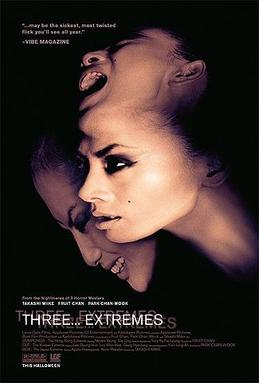
This one inspired and stimulated by Fruit Chan's Dumplings segment off of Three...Extremes. Dumplings follows an aging actress desiring to be 'young' again. She goes to a medicine woman who makes dumplings supposedly having regenerative powers. These regenerative properties derived from the primary ingredient of human fetuses and unborn babies. Disturbing, I agree. But, this is part of horror's appeal to me as a genre. Horror, more so than any other genre, carries the built-in capacity to depict us in our most polarized, barbaric and perverse incarnation. It reveals our greatest fears, but more so, the beast brimming within all of us. Great horror cinema is revelatory and searingly honest in that sense.
The thing about the grotesque, physical act of cannibalism, especially with unborn babies as depicted in Dumplings, is that we find this completely barbaric, uncivilized, and ugly - to eat another human being wholly inhuman. In the film, the aging actress does this to regain this illusive youth-lost, equating it to her waning physical appearance. Pursuing this vain concept of beauty at any cost, becoming less human with ever dumpling purchased, not understanding that space-time will never stop for the material, the physical. Fruit Chan undoubtedly commenting on the state of hypercapitalism, but more simply, the fruitless hunt for immortality.
But, as abstracted as this cannibalism may seem, are we not culpable for this same act? Merely glossed over, indirect, at a distance, as to not make us seem so grotesque and inhuman. We consume without conscience of repercussions. This hypercapitalistic beast we perpetuate making us into a bulimic cannibal addicted to acquisition and material compensation. Ironically, this pursuit killing people and unborn babies in far greater numbers than physical cannibalism ever could.
I understand the complications hindering us, I'm a product of this too. I understand it can't be done all at once. But something can be done. You don't have to boycott all fast food chains, just a couple. You don't have to boycott all large, discount department stores, just one. You don't have to boycott television, just the majority of FOX programming.
fleshing it out
A hotstove topic over the years has been the depiction of violence in visual media, especially cinema. The graphic exploitation of flesh in American cinema becoming more apparent and explicit in recent years. Overblown whistle-blowers were concerned about the societal ripple effect. I don't completely disagree with them, but I don't agree either. It's the romantic idealist in me that sees it as necessary revelation. Take Tarantino and Eli Roth for example, two primary auteurs of this conversation. Their exaggerated, hyperreal approach to graphic violence actually more honest, and closer to reality than previously before. In Hostel, that's how an Achilles looks when it gets slit. Violence IS graphic. Lurid. This is the key: depicting it in such a kitsch, pornographic way abstracts it, makes it unreal. It makes the viewer only a voyeur, not actionable. This extends to video games. It becomes existentialized, becoming more a vicarious release (though, I do see video games in a more problematic sense - the deprivation of active imagination).
This visual oppression of gore, the mutilated flesh, and the flesh in general, carries a simpler intonation in us: fear of mortality, imperfection. As with any thing that reminds us of this, we insecurely subjugate it. But, I compare works like Grindhouse and Hostel to the transition being expressed in pugilistic entertainment. The transition from contrived, insincere violence (WWE) to fighting that carries real consequence, the mixed martial arts of UFC.
As exploitative and grotesque as may seem, this honest visualization of the flesh has allowed for the most profound human act to finally be sincerely celebrated: the female giving birth to child. Before it was always close-up on woman -hair perfectly styled, make-up newly applied- whimsically pushing, then cut to: Whoosh! pleasant, little bundle of joy gift-wrapped directly from the heavens. No sweat, no struggle, no signs of an umbilical chord, no beauty. In recent years, however, we have finally seen the true beauty of childbirth. Messy, harrowing, and heroic. To name a few works that celebrate this beautiful struggle: Children of Men, Knocked Up, and Eastern Promises.
Subscribe to:
Posts (Atom)